In the era of evolving artificial intelligence, machines are increasingly emulating human-like capabilities, including visual perception and linguistic expression. Image captioning stands at the intersection of these domains, enabling machines to interpret visual content and generate descriptive text. This paper provides a thorough review of image captioning techniques, catering to individuals entering the field of machine learning who seek a comprehensive understanding of available options, from foundational methods to state-of-the-art approaches. Beginning with an exploration of primitive architectures, the review traces the evolution of image captioning models to the latest cutting-edge solutions. By dissecting the components of these architectures, readers gain insights into the underlying mechanisms and can select suitable approaches tailored to specific problem requirements without duplicating efforts. The paper also delves into the application of image captioning in the medical domain, illuminating its significance in various real-world scenarios.
@article{singh2026pixelstoprose,title={Pixels to Prose: Understanding the Art of Image Captioning},author={Singh, Hrishikesh and Sharma, Aarti and Pant, Millie},journal={Neurocomputing},year={2026},publisher={Elsevier},volume={xxx},number={xxx},pages={xxx--xxx},doi={10.1016/j.neucom.2025.132385},url={https://doi.org/10.1016/j.neucom.2025.132385},}
Under Review
Reading the Mask: Descriptor-Grounded BI-RADS Rationale Generation for Breast MRI Segmentation
Aarti Sharma, Hrishikesh Singh, Divyanshu Kumar, and 1 more author
Under review (Aarti Sharma and Hrishikesh Singh contributed equally) , 2026
@article{sharma2026readingthemask,title={Reading the Mask: Descriptor-Grounded BI-RADS Rationale Generation for Breast MRI Segmentation},author={Sharma, Aarti and Singh, Hrishikesh and Kumar, Divyanshu and Pant, Millie},journal={Under review},year={2026},}
ICEP
YOLOv12-P4: Enhancing Small Object Detection in Infrared Imagery via a High-Resolution Feature Head
Hrishikesh Singh, Aarti Sharma, and Millie Pant
In Proceedings of the International Conference on Electro-optics and Photonics (ICEP), 2026
Infrared small target detection remains challenging because targets occupy only a handful of pixels, carry little texture, and are easily lost against cluttered thermal backgrounds. We introduce YOLOv12-P4, an extension of the YOLOv12 detector with an additional high-resolution P4 feature head that preserves fine spatial detail through the neck and prediction stages. The added head recovers weak, low-contrast signatures that are suppressed by aggressive downsampling in standard detection pyramids, while keeping the inference cost suitable for deployment on infrared imaging platforms. Experiments on infrared small target detection benchmarks show consistent gains over the baseline detector, particularly for the smallest object scales.
@inproceedings{singh2026yolov12p4,title={YOLOv12-P4: Enhancing Small Object Detection in Infrared Imagery via a High-Resolution Feature Head},author={Singh, Hrishikesh and Sharma, Aarti and Pant, Millie},booktitle={Proceedings of the International Conference on Electro-optics and Photonics (ICEP)},series={Springer Proceedings in Physics},volume={374},year={2026},publisher={Springer},}
2025
Preprint
Breaking the Domino Chain: Using Causal AI to Anticipate and Reduce Manufacturing Downtime
One of the significant challenges of manufacturing industries is downtime which could be attributed to different causes, including a process or component failure. We propose a novel framework which helps in downtime prediction using deep learning. In addition, we utilize Causal AI techniques to identify the underlying causes and the cascading failure subcomponent topological order, which influenced the downtime impact. We employed supervised machine learning for downtime prediction and causal AI techniques, including the PC (Peter-Clark) algorithm and Granger Causality for gaining insight into operational dependencies to improve the production workflow.
@misc{singh2025dominocausalai,title={Breaking the Domino Chain: Using Causal AI to Anticipate and Reduce Manufacturing Downtime},author={Singh, Hrishikesh and Sharma, Aarti and Pant, Millie},year={2025},primaryclass={cs.LG},}
Poster
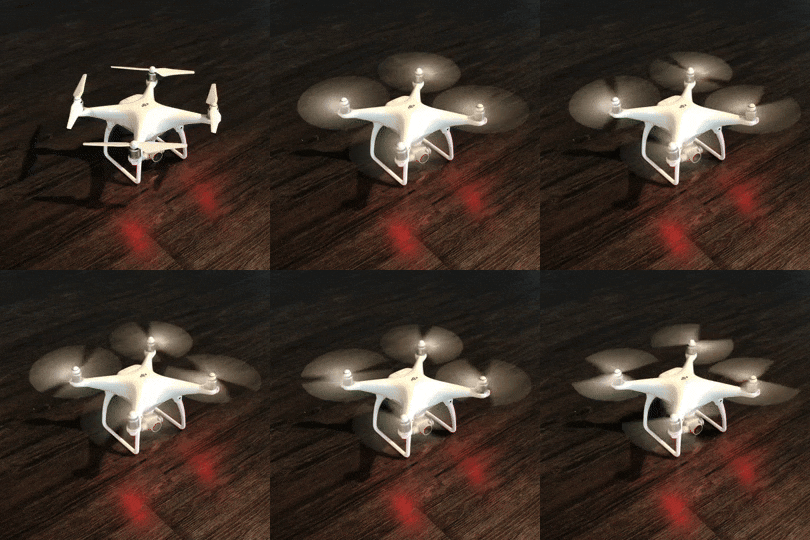
Autonomous Drone Swarm Navigation in a 2D Grid Environment Using Reinforcement Learning
@misc{singh2025drldrone,title={Autonomous Drone Swarm Navigation in a 2D Grid Environment Using Reinforcement Learning},author={Singh, Hrishikesh and Sharma, Aarti and Pant, Millie},year={2025},primaryclass={cs.RO},}
In modern financial markets, more than 3/4th of the large volume trade is executed by algorithmic trading based on advanced trading strategies to attain higher precision and speed than traditional human traders. The conventional strategies focused on price-based indicators are inadequate in capturing the market dynamism arising from real-world events such as social sentiments, political instability, or sudden economic shifts. With the rise of Deep Reinforcement Learning (DRL) and data availability, there is a requirement for more efficient algorithms that can incorporate these external factors in trading strategies. In this paper, we propose a DRL approach based on partial and deep-infusion of sentimental analysis, featuring distinct policy designs of actor-critic-based agents.
@article{singh2024financialrl,title={Financial Context-Aware Multiagent-Based Reinforcement Learning Approach for Indian Stock Portfolio Optimization},author={Singh, Hrishikesh and Sharma, Aarti and Pant, Millie},journal={Intelligent Data-Driven Systems and Artificial Intelligence},month=aug,year={2024},publisher={Taylor and Francis},}
2018
IC3
Empirical Analysis of Bitcoin Market Volatility Using Supervised Learning Approach
Hrishikesh Singh and Parul Agrawal
In International Conference on Contemporary Computing (IC3), Aug 2018
Cryptocurrencies are considered as the next model of economics and monetary exchange. In recent years, popular cryptocurrency such as Bitcoin and Ethereum witness an exponential growth in economic sphere. In this paper empirical testing of four conventional machine learning methods is performed to predict the bitcoin prices using last eight years of transactional data. Linear and polynomial regression is implemented using all the features individually. Polynomial regression, Support Vector regression and KNN regression are hyper tuned with grid search logic. Results depicted that KNN regression outperformed others models.
@inproceedings{IC3,title={Empirical Analysis of Bitcoin Market Volatility Using Supervised Learning Approach},author={Singh, Hrishikesh and Agrawal, Parul},booktitle={International Conference on Contemporary Computing (IC3)},pages={1--5},year={2018},month=aug,publisher={IEEE},doi={10.1109/IC3.2018.8530636},url={https://ieeexplore.ieee.org/document/8530636},}